Resources
2025-2026 Year in Review: AI in Education Policy News
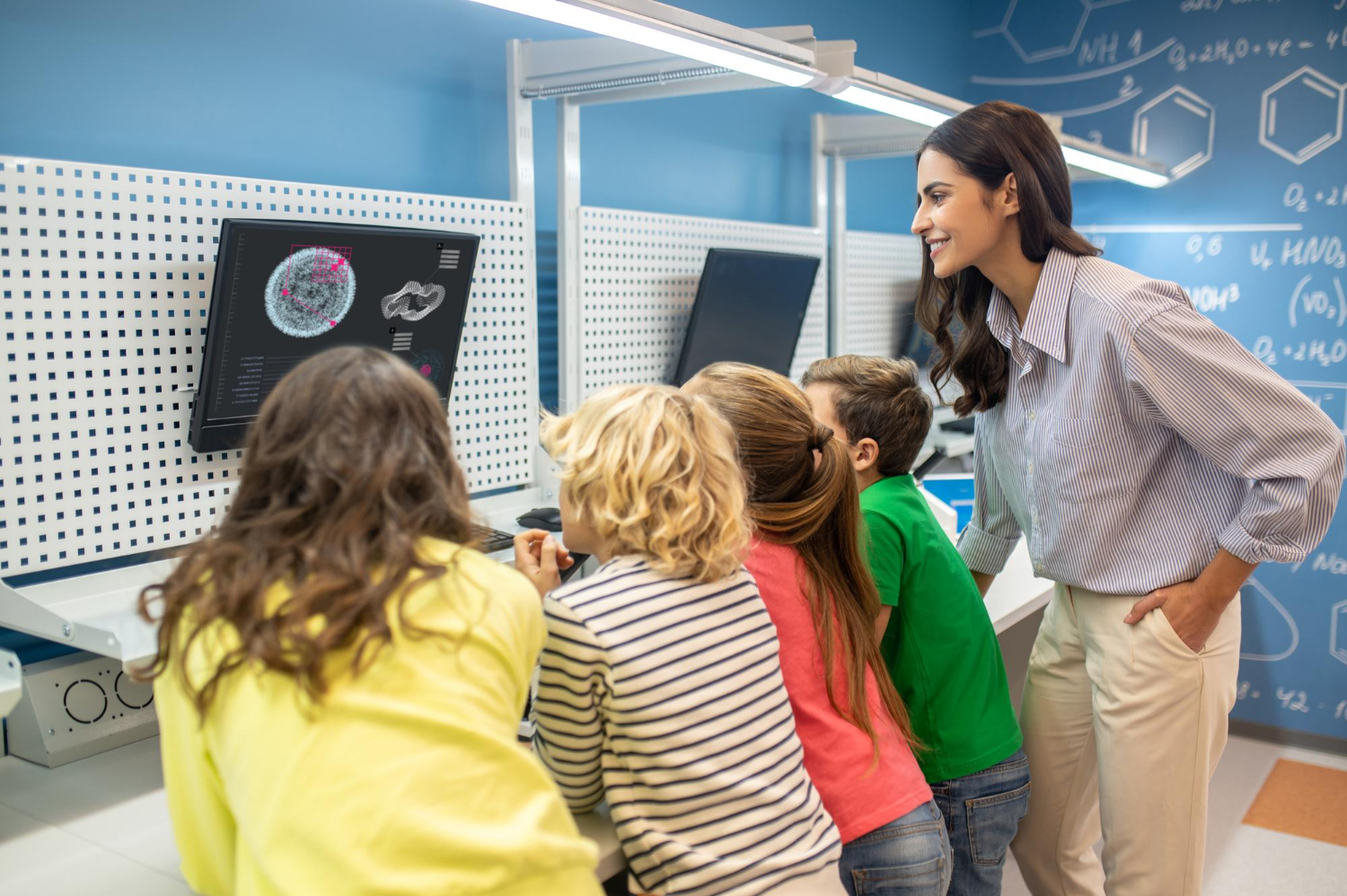
Bans, regulations, and guardrails: It has been a contentious year for AI in education. As the technology entrenches in everyday life and inevitably makes it into classrooms, whether mandated or not, parental, teacher, and administrative organizations have raised their voice to foster its responsible use.
AI has also emerged at a time when students struggle with literacy and numeracy rates, as Gen Z becomes the first generation less cognitively capable than their parents, with neuroscientists pointing to technology as the culprit. This, plus the assertion that AI can harm deep thinking, has been a cause for concern in education.
However, school staff like Tim Klan, an administrator of information and instructional tech at a Michigan public school, say the 2026-2027 school year will mark the transition of AI from a fun novelty to a daily tool for personalizing how students learn. The tech, according to him, will act as a sidekick that aids teachers in giving targeted support rather than replace traditional teaching.
The sector has also experienced novel tech bans, such as in one of California’s biggest school districts, the Los Angeles Unified School District (LAUSD), and in New York. Whether these prohibitions will reap positive results or not remains to be seen, but they’re a clear statement of a widespread negative sentiment toward AI.
Keep reading to learn what studies reveal about the impact of AI on education, from teachers to students, and the latest policies that will shape this upcoming school year.
The Benefits of AI in Education for Teachers
In conversation with e-School News, VP of Photon Education in North America, Chris Klein, expressed that classrooms will most likely favor more in-person approaches rather than virtual ones as more districts implement screen-time mandates. But this doesn’t mean AI is going anywhere. For him, it will be most valuable when it supports teachers without replacing meaningful instruction, making student learning more tangible, visible, and measurable.
This makes sense as the number of teachers using AI has increased in the past year: In 2023, only 34% said they used it from a little to a lot. While the number slightly dipped in 2024, the following year, 61% said they used it at work in some capacity. According to the study, this increase is due to more professional development (PD) instruction regarding AI, which helps teachers gain confidence in tech tools when taught how to use them specifically for educational purposes.
The Importance of PD in Today’s Tech Boom
It’s true that adding one more tech tool to teachers’ already toppling stack of software programs isn’t ideal. However, it seems like AI is becoming an exception, with the promise of reducing administrative burdens and enhancing instructional methods with higher personalization, helping them save time.
However, outlets such as Education Week consider that, upon surveying K-12 teachers, the right question isn’t whether AI is helping them save time, but whether it’s making the job feel more manageable. Their survey found that AI anxiety is catching up to teachers as another tool in their deck. Those who didn’t feel anxiety but felt confidence in using it were also able to manage their workload much better.
The secret to a better 2026-2027 school year with AI seems to be proper tech usage, which is often possible only through PD. As such, helping teachers catch up to the technology can ease their anxiety and help them adopt it in a way that creates real impact in their students’ learning
Benefits of AI in Education: More Time for What Matters
Returning to personalization and how AI in education can help teachers connect more with their students, Amy Malay, a Bay Area Elementary teacher, recently agreed. Although she asserted it isn’t a foolproof solution yet, she found its benefits after properly learning how to use it. “If you can use the tool in the way it’s intended, it has a benefit,” revealing that it also helped unburden her of administrative tasks, calling it an assistant.
Ultimately, Malay expressed that critical thinking is more important now than ever before.
It’s teachers ready to try new tools that inspired Claude to launch a specific platform for them in July, called Claude for Teachers. Verified K-12 US teachers can use its premium features for free with integrated state standards, citing that AI can improve student outcomes and allow teachers to spend more time with students rather than on planning and other tasks.
Students and Classroom Engagement with AI
As children are exposed to the internet at younger ages, it’s safe to assume that K-12 students aren’t oblivious to AI outside of the classroom. Regardless of their after-school exposure to the technology, introducing it during lessons has become more commonplace as teachers experiment with it and integrate it into school.
As a tool still emerging in the education sector, causal evidence on the impact of AI on students is still fairly limited, according to Stanford’s AI Hub for Education. The review still suggests that, through valid findings, AI has a positive impact when guardrails are implemented.
For instance, the research found that AI tools improve student performance in subjects like math, programming, and writing when students have active access to them. However, heavily leaning on AI to alleviate cognitive burden can lead to a lack of deep thinking, making the right approaches to the tech crucial to avoid this from happening at such critical ages.
Seeking tools that foster independent thinking instead of completely taking over can be a great way to start. AI chatbots specifically designed for tutoring with step-by-step reasoning and feedback rather than directly completing assignments for students can prove to be more effective than general-purpose chatbots.
This is why guardrails matter and should become more present in this 2026-2027 school year. A tool built on state standards to accommodate specific learning needs is more beneficial to student learning than one designed to address any and all prompts without considering its context.
2025-2026 AI in Education Policy News: The Landscape for the New School Year
The past two years have been marked by some of the most relevant AI and tech policies in the country’s biggest school districts. For instance, Chicago Public Schools (CPS), the third-largest US school district, delivered an AI guidebook in 2024, which it has updated regularly to set guardrails for everyone, from staff to students, regarding tech usage. While it recognizes the opportunities found in AI, it also points to its faults and how schools should address them.
Chicago’s policies are well-received in a field still vastly split on AI adoption, where most school districts either shy away from making specific rules on which platforms to use and how, or don’t announce policies at all. In fact, a study published earlier this year found that only 18% of school teachers receive formal guidance on how to use AI.
Moreover, although districts like LAUSD and New York City have announced clearer bans on screens this year, they’re still uncertain about AI after initially banning platforms like ChatGPT, then walking back the decision. Both of these districts, the two largest in the country, have now enforced full bans on generative AI, the former making it temporary, as they build policies on the go.
This anti-tech and AI sentiment has made it hard for the technology to be fully developed in educational contexts. The regulatory uncertainty makes it even harder for schools to take the initiative to set their own guardrails while districts make their own, setting the stage for a confusing 2026-2027.
What’s clear is that AI shows positive signs for students and teachers when used intentionally and without full reliance on it for critical thinking tasks or decision-making. If or when these advantages are made apparent, bans will be tougher to approve, but several sectors will still push back in favor of less-intervened educational models. Ultimately, it’s all about balancing analog and virtual learning to hone students’ digital skills while focusing on hands-on approaches and improved literacy levels.
If you’re looking for an AI-assisted tool that can streamline test creation and grading, Quizli has your back. And our platform goes even further, making it easy to analyze class performance through reports, help students with learning disabilities with integrated accessibility tools, and create rubrics for more personalized grading.
If you’re interested in being part of the first batch of teachers enjoying Quizli, contact our team to get started!